If a payment fails in China, do not hold up the checkout while repeatedly editing your account.
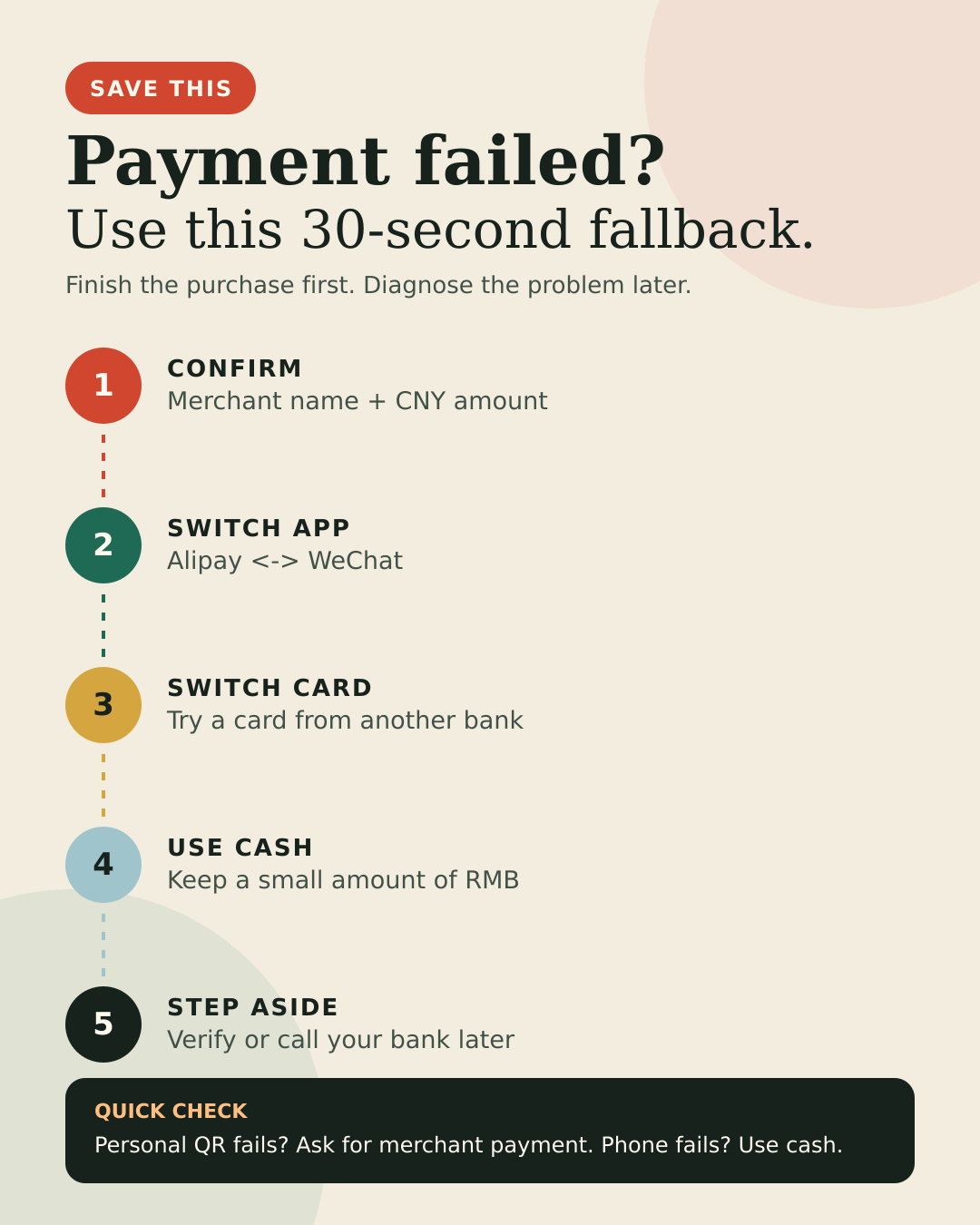
Use this order instead:
- Confirm the merchant and CNY amount.
- Switch between Alipay and WeChat.
- Try a card from a different bank.
- Pay with cash.
- Step aside, then fix verification or call your bank.
The goal at the checkout is to complete the purchase, not diagnose every possible cause. A second payment route is usually faster than repairing the first one on the spot.
1. Your linked bank card is declined
The problem may be your card issuer rather than the Chinese app. A bank can block an overseas, online, or digital-wallet transaction.
Try these checks in order:
- Make sure overseas and online payments are enabled.
- Try a card issued by a different bank.
- Check that the card is not expired, frozen, or over its limit.
- After leaving the checkout, tell your issuer you are using the card through Alipay or WeChat in China.
Do not keep repeating the same failed transaction. Several attempts in a short period can trigger more risk controls.
Bottom line: Two cards from different banks are more useful than two cards from the same bank.
2. The QR code scans, but payment does not work
First find out whether you are paying a merchant or an individual.
- Merchant QR codes are generally the better route for a visitor using an international card.
- Personal collection codes, friend transfers, and red packets may be restricted.
- If scanning the merchant’s code fails, show the cashier your own payment code.
- Then switch app, or ask whether the merchant accepts cash or a physical card.
Do not assume that because Alipay can scan one code, WeChat will complete the same type of transaction.
Bottom line: Separate a merchant payment from a personal transfer before deciding that your account is broken.
3. Identity verification or your name fails
Enter your name exactly as it appears on your passport and card. Check:
- name order
- middle names
- spaces, hyphens, and spelling
- passport validity and whether the document photo is clear
If the app asks for more verification, handle it somewhere secure with a stable connection. Do not create several accounts just to rush a payment, and never hand your passport or bank card to a stranger for help.
Bottom line: Do not repair an identity problem at the checkout. Use your backup method first.
4. The SMS verification code never arrives
- Keep the phone number used for registration able to receive international SMS.
- If an eSIM provides your data, do not disable SMS on your original number.
- Check the country code and number.
- Wait before requesting another code instead of tapping repeatedly.
- If this already fails before departure, solve it before boarding your flight.
Bottom line: Your data SIM and verification number can be different, but the original number still needs to work.
5. Your phone has no data or battery
Mobile payment depends on a working phone, a connection, and an app that opens.
Before leaving your hotel, check your roaming or eSIM, carry a power bank, and keep a small amount of Chinese cash. Save screenshots of your hotel’s Chinese address, important bookings, and train tickets too.
Bottom line: Cash and a power bank are not outdated. They are insurance for a phone-based trip.
6. A fee or exchange rate appears
Fee promotions for international cards can change. The exchange rate may also be set by the card network and issuer.
Before confirming, check the merchant, CNY amount, fee, and estimated charge. If the cost is unacceptable, switch app or card. Your card statement provides the final posted exchange rate.
Bottom line: Trust the current confirmation screen and your bank statement, not an old promise of permanently fee-free payment.
7. A refund has not arrived
First confirm that the merchant sent the refund from the original transaction. Save the order number and refund record.
Refunds normally return through the original payment route, but timing can depend on the payment platform, card network, and issuer. If the merchant confirms the refund and it still does not arrive after the stated processing time, contact the platform and your bank.
Do not scan a new QR code from a stranger who says it is needed to “receive” your refund.
Bottom line: Confirm with the merchant first, then follow up with the platform and card issuer.
Your 30-second fallback
- Alipay fails: switch to WeChat.
- WeChat fails: switch to Alipay.
- The same card fails: use a card from another bank.
- A personal QR code fails: ask for a merchant payment route.
- Your phone or data fails: use cash.
- Nothing works: step away from the checkout, then contact your bank or the platform.
Final answer: A failed payment does not mean you cannot buy things in China. Do not depend on one app, one bank card, or one internet connection. A prepared second route is usually the quickest fix.
Continue reading
- How to Pay in China: 4 Things to Set Up Before Your Trip
- How to Set Up Alipay and WeChat Pay as a Foreign Visitor
- Can You Use PayPal, Apple Pay, Google Wallet, or Your Home E-Wallet in China?
Sources checked for this update
- China Government / Xinhua, Payment service guide for overseas visitors to China, April 11, 2024
- Alipay+, international-wallet and international-card guidance for the Chinese mainland, checked September 8, 2026
- Tencent, inbound-payment and international-card fee-promotion guidance, updated June 5, 2026; checked September 8, 2026
- Beijing Government, international-card binding guidance for Alipay and WeChat, checked July 19, 2026