Guangzhou is often introduced through dim sum, the Canton Tower, and a humid skyline beside the Pearl River. All three belong here. None of them, on its own, explains why the city feels so open, layered, and intensely lived in.
Begin somewhere smaller and more detailed: look up at the roof of Chen Clan Ancestral Hall.
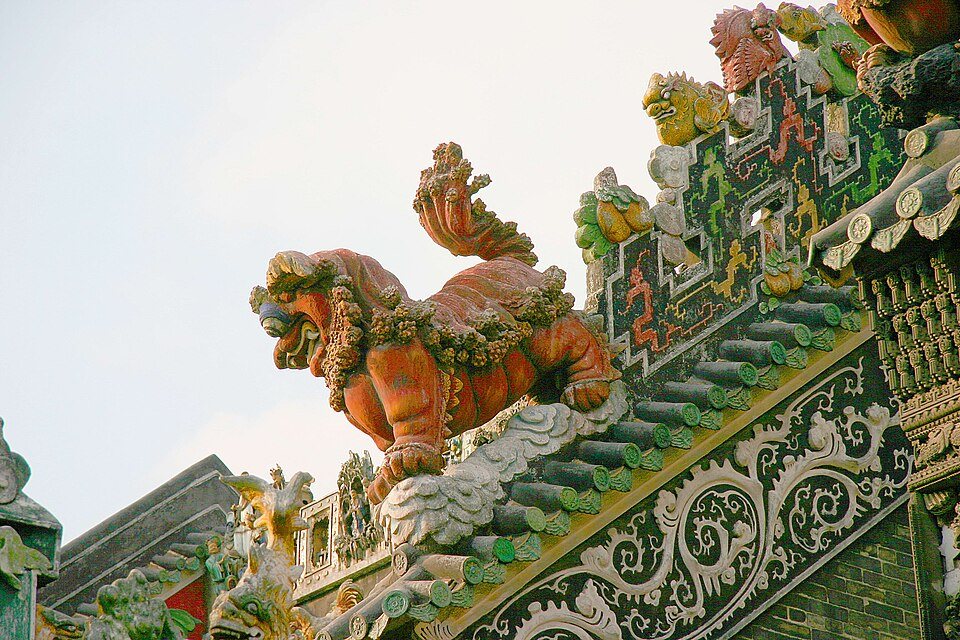
The colored figures, flowers, animals, and stories along its roof ridges are not simply decoration. They belong to a building where clan organization, education, skilled making, and life in the provincial capital once met. From there, widen the view toward the Pearl River, the old commercial districts, and a city that has dealt with the wider world for centuries.
A roof can introduce a whole city
Chen Clan Ancestral Hall, also known as the Chen Clan Academy, was completed near the end of the Qing dynasty. It was built through the support of Chen clans from different parts of Guangdong and served religious, educational, and practical purposes for clan members coming to the provincial capital. Today it houses the Guangdong Folk Arts Museum.
Its architecture asks you to slow down. Wood, stone, and brick carving appear beside pottery and lime-based relief work. Figures from stories, flowers, birds, animals, pavilions, and layered landscapes move across roof ridges, doors, beams, and walls.
The bright work that first catches the eye along the roof is commonly described as pottery ridge decoration. The building also contains huīsù, relief forms built up with lime-based materials, as well as carved wood, stone, and brick. These techniques can look similar from a distance, so resist the urge to call every colored surface “porcelain carving.”
The important lesson is simpler: in Guangzhou, history is not always held in one monumental facade. It may be made visible through material, repetition, and the hands of many craftspeople.
The Pearl River opens the view outward
Guangzhou’s official city history reaches back more than 2,200 years. Its position in southern China and its access to river and maritime routes helped it become an important city of trade and exchange. Guangzhou is often called a “millennium trading city” and has long been associated with the Maritime Silk Road.
That history should not be turned into a smooth celebration of prosperity. Trade also brought conflict, imperial pressure, war, unequal treaties, migration, and repeated changes in who controlled space and commerce.
Shamian is one place where that difficult inheritance is visible. Its tree-lined streets and surviving historic buildings are often presented as a European-style photo stop. But the island’s modern form is tied to the foreign concessions, consulates, and trading institutions created under unequal colonial power in the 19th century. You can appreciate its architecture without deleting the history that produced it.
The river still matters, although the city no longer depends on the same docks or commercial geography. Walk a section of the waterfront in the evening and watch what people actually do there: talk, exercise, sing, wait, and look across the water. The skyline is only the backdrop.
Life continues under the arcades
Guangzhou’s arcaded streets, or qílóu, are not just a nostalgic visual style. Their covered walkways answer a practical southern climate of strong sun and sudden rain while bringing shops and pedestrians into the same shaded edge.
Do not assume every arcade comes from one period or represents one building type. What matters on a first walk is how architecture participates in ordinary life: a storefront opening into the covered passage, a scooter passing the columns, rain brightening the road, or a conversation continuing without everyone stepping into the sun.
Morning tea works in a similar way. It is not a challenge to order every famous dumpling. It is time set aside to sit, share, refill the teapot, and talk. Start with a few dishes and add more if the table still wants them. Check the restaurant’s current hours and queueing system rather than assuming every place serves the same menu all day.
Markets, fruit stalls, neighborhood seats under banyan trees, Cantonese heard on the street, and the different pace of old and new districts all belong to the living city. Cantonese is worth noticing and respecting, but visitors do not need to master it before entering Guangzhou.
Guangdong does not have only one local culture
Guangfu culture is central to Guangzhou’s local history. But Guangzhou is also a provincial capital, transport hub, and trading city where people from many parts of Guangdong and beyond have met.
Chaoshan and Hakka cultures are not two branches of “Guangzhou culture.” They have their own regions, languages, migration histories, foodways, and social networks. In Guangzhou you may encounter Chaozhou food, gongfu tea, Hakka dishes, businesses, and communities connected to those traditions. That encounter is real, but eating one meal in the provincial capital is not the same as understanding the places those cultures come from.
For a first-time visitor, the useful idea is not to flatten them into one vague “Lingnan style.” It is to notice why a large southern capital has become a meeting place for distinct regional lives.
Do not turn heritage into a collection game
Chen Clan Ancestral Hall is not isolated, but “nearby” means the scale of Guangzhou’s old city—not that every protected building stands beside its gate.
Guangzhou’s official national heritage list identifies three nationally protected sites in Liwan District:
- Chen Clan Ancestral Hall;
- the Shamian architectural group, which the official register treats as a group of 54 components rather than one photogenic building;
- the former Yuehai Customs site on Yanjiang West Road.
They should not be forced into one long walk simply because they share a protection level. A better plan separates three questions.
How does craft enter ordinary life?
Start at Chen Clan Ancestral Hall, then make a short transit connection to Pantang. From there, walk through Liwan Lake and Lychee Bay toward Liwan Museum, the Cantonese Opera Art Museum, Yongqingfang, and Enning Road.
Only Chen Clan Ancestral Hall is the national heritage anchor on this route. The other stops matter because they show Xiguan’s water system, domestic scale, gardens, opera, adaptive reuse, and street life. Museums provide context and an indoor pause; they are not there simply to increase the attraction count.
Suggested shape:
Chen Clan Ancestral Hall → short transfer → Pantang and Liwan Lake → Liwan Museum → Lychee Bay → Cantonese Opera Art Museum → Yongqingfang and Enning Road
How did Guangzhou trade with the world?
Keep the river-and-trade story for a separate half day:
Thirteen Factories Museum → Yuehai Customs site → Xidi waterfront → Shamian architectural group
The Thirteen Factories Museum explains the commercial network, but the museum itself is not one of the nationally protected sites named above. Yuehai Customs and Shamian carry that status. Read Shamian’s buildings alongside concession history and unequal colonial power, not as an empty European-style backdrop.
What else belongs to the old-city heritage map?
East of Chen Clan Ancestral Hall, the adjoining Yuexiu old city contains four more nationally protected sites that can form an optional north-to-south study:
Guangxiao Temple → Six Banyan Temple Pagoda → Huaisheng Mosque Light Tower → Five Immortals Temple and Lingnan First Tower
This is a religion-and-old-city route, not an extra checklist for every first visit. National protection does not guarantee that every interior is open. Check current access, worship etiquette, and photography rules before going.
Build three days by area and weather
Guangzhou is large, hot, humid, and often rainy. A comfortable plan keeps each day geographically coherent and leaves room to exchange indoor and outdoor time.
Day one: Chen Clan Ancestral Hall and Xiguan life. Give the building enough time to look at roof ridges, doors, beams, and different materials. Make a short transfer to Pantang, then walk through Liwan Lake and Lychee Bay toward Liwan Museum, the Cantonese Opera Art Museum, Yongqingfang, and Enning Road. Choose one unhurried tea or meal rather than racing through every old-street name.
Day two: trade, customs, and Shamian. Begin with the Thirteen Factories Museum for context, then continue to the Yuehai Customs site, Xidi waterfront, and Shamian. Read the colonial and commercial history before treating Shamian as scenery. Let people using the riverfront become the evening’s final scene.
Day three: contemporary Guangzhou. Keep Huacheng Square, Guangzhou Opera House, and the public spaces of Zhujiang New Town together. The point is not a tower count. Notice how rain, underground commerce, cultural buildings, plazas, and the skyline organize life in the present city.
Move outdoor walks toward the morning or evening in hot weather. Keep a museum, long meal, or other indoor stop available for the middle of the day. Heavy rain may change the order; it does not have to erase the whole day.
Guangzhou’s old districts are not the only places with a soul, and Zhujiang New Town is not a meaningless glass epilogue. The city is most convincing when you allow the crafted roof, the shaded arcade, the shared table, and the contemporary riverfront to belong to the same story.
Continue reading
- Open the Guangzhou City Desk
- How to Ride the Metro in China
- At the Chinese Table: A First-Time Visitor’s Guide
- How to Book Attraction and Museum Tickets in China
Sources checked for this update
- Guangzhou Municipal Government English portal, About Guangzhou, city history, food, and tourism pages, checked August 1, 2026
- Guangzhou Municipal Government, cultural and tourism policy materials describing the Flower City, Lingnan culture, Maritime Silk Road culture, and Guangzhou’s role as a trading city
- Guangzhou Municipal Government, Guangzhou National Key Cultural Relics Protection Units List, updated May 27, 2026, including the 54-component appendix for the Shamian architectural group
- Guangzhou Municipal Government, One guide is enough for a Xiguan City Walk, used as thematic source material and reorganized here by geography rather than copied as a continuous route
- Liwan District Government, Chen Clan Ancestral Hall craft overview using the traditional categories of carving, pottery and lime-based relief work
- Guangdong Folk Arts Museum public information on Chen Clan Ancestral Hall
- Hong Kong Antiquities and Monuments Office, 2022 conservation conference proceedings on Chen Clan Ancestral Hall
- Guangzhou local-history and planning materials on Shamian’s concession-era history
Photo on this page
The Chen Clan roof-ridge detail is by zengsx, used under CC BY-SA 3.0 via Wikimedia Commons.
